


 Email the author
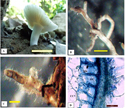
Ectomycorrhizal biology of Shorea robusta roots in association with Russula Pers. (Russulaceae; Basidiomycota) from foothills of Himalayas, India
Abstract
Keywords
Full Text:
PDFReferences
Agerer R. Studies on ectomycorrhizae III. Mycorrhizae formed by four fungi in the genera Lactarius and Russula on spruce. Mycotaxon 27 (1986): 1-59.
Agerer R. Colour atlas of ectomycorrhizae. 1st–15th ed.–Einhorn Verlag, Schwäbisch Gmünd, Germany, 1987-2012.
Agerer R. Fungal relationships and structural identity of their ectomycorrhizae. Mycological Progress 5 (2006): 67-107.
Agerer R. and G. Rambold. DEEMY –A DELTA based Information System for Characterization and Determination of Ectomycorrhizae by Ludwig-Maximilians-Universität München, Dept. Biologie I–Systematische Mykologie, München, Germany. http://www.deemy.de, 2004-2020.
Alexander I. and M.A. Selosse. Mycorrhizas in tropical forests: a neglected research imperative. New Phytologist 182.1 (2009): 14-16.
Atri N.S., A. Kaur and H. Kour. Wild Mushrooms - Collection and Identification. In: Rai R.D., R.C. Upadhyay and S.R. Sharma eds., Frontiers in Mushroom Biotechnology NRCM Chambaghat, Solan, India, 2005, pp. 9-26.
Atri N.S. and S.S. Saini. Collection and study of Agarics- An introduction. Indian Journal of Mushroom 18 (2000): 1-5.
Atri N.S., S. Sharma, M.K. Saini and K. Das. Researches on Russulaceous mushrooms. Kavaka 47 (2016): 63-82.
Avis P.G. Ectomycorrhizal iconoclasts: the ITS rDNA diversity and nitrophilic tendencies of fetid Russula. Mycologia 104.5 (2012): 998-1007.
Ba A.M., R. Duponnois, B. Moyersoen, G. Abdala and A.G. Diedhiou. Ectomycorrhizal symbiosis of tropical African trees. Mycorrhiza 22 (2012): 1-29.
Beenken L. Russula cyanoxantha (Schaeff.) Fr., + Fagus sylvatica L. Description of Ectomycorrhizae 5 (2001): 131-137.
Beenken L. Die Gattung Russula. Untersuchungen zu ihrer Systematik anhand von Ektomykorrhizen. Dissertation, Universität München.http://edoc.ub.uni-muench en.de/arch ive/00003175/01/Beenken Ludwig. Pdf, 2004.
Burlingham G.S. Notes on species of Russula. Mycologia 16 (1924): 16-23.
Champion H.G. and S.K. Seth. A revised survey of the forest types of India. New Delhi Manager of Publications, Govt. of India, 1968, pp. 404.
Corrales A., A.E. Arnold, A. Ferrer, B.L. Turner and J.W. Dalling. Variation in ectomycorrhizal fungal communities associated with Oreomunnea mexicana (Juglandaceae) in a Neotropical montane forest. Mycorrhiza 26 (2016): 1-17.
Henkel T.W., M.C. Aime, M.M.L. Chin, S.L. Miller, R. Vilgalys and M.E. Smith. Ectomycorrhizal fungal sporocarp diversity and discovery of new taxa in Dicymbe monodominant forests of the Guiana Shield. Biodiversity Conservation 21 (2011): 2195-2220.
Kirk P.M. Species Fungorum (Version October, 2014). In: Species 2000 & ITIS Catalogue of life. Species 2000 & ITIS Retrieved, 2014 (latest update: October 30, 2014).
Kornerup A. and J.A. Wanscher. Methuen Handbook of Colour. 3rd ed. –Eyre Methuen, London, 1978.
Kumar J. and N.S. Atri. Characterisation of ectomycorrhiza of Russula and Lactifluus (Russulaceae) associated with Shorea robusta from Indian Shiwaliks. Nova Hedwigia 103.3-4 (2016): 501-513.
Kumar J. and N.S. Atri. Characterisation and identification of ectomycorrhizae of Russula (Russulaceae: Basidiomycota) associated with Shorea robusta. Journal of Tropical Forest Science 31(2019): 114-124.
Lee L.S., I.J. Alexander and R. Watling. Ectomycorrhiza and putative ectomycorrhizal fungi of Shorea leprosula Miq. (Dipterocarpaceae). Mycorrhiza 7 (1997): 63-81.
Malysheva E.F., V.F. Malysheva, A.E. Kovalenko, E.A. Pimenova, M.N. Gromyko, S.N. Bondarchuk and E.Y. Voronina. Below-ground ectomycorrhizal community structure in the postfire successional Pinus koraiensis forests in the central Sikhote-Alin (the Russian Far East). Botanica Pacifica 5.1 (2016) 19-31.
Mohan V., K. Natarjan and K. Ingleby. Anatomical studies on ectomycorrhizas I. The ectomycorrhizas produced by Thelephora terrestris on Pinus patula. Mycorrhiza 3 (1993a): 39-42.
Mohan V., K. Natarjan and K. Ingleby. Anatomical studies on ectomycorrhizas II. The ectomycorrhizas produced by Amanita muscaria, Laccaria laccata and Suillus brevipes on Pinus patula. Mycorrhiza 3.1 (1993b): 43-49.
Mohan V., K. Natarjan and K. Ingleby. Anatomical studies on ectomycorrhizas III. The ectomycorrhizas produced by Rhizopogan luteolus and Scleroderma citrinum on Pinus patula. Mycorrhiza 3.2 (1993c): 51-56.
Natarajan K., G. Senthilrasu, V. Kumaresan and T. Riviera. Diversity in ectomycorrhizal fungi of a dipterocarp forest in Western Ghats. Current Science 88.12 (2005): 1893-1895.
Pešková V.Z., J. Landa and R. Modlinger. Long term observation of mycorrhizal status and above-ground fungi fruiting body production in oak forest. Dendrobiology 69 (2013): 99-110.
Pyasi A., K.K. Soni and R.K. Verma. Dominant occurrence of ectomycorrhizal colonizer Astraeus hygrometricus of Sal (Shorea robusta) in forest of Jharsuguda Orissa. Journal of Mycology and Plant Pathology 41.2 (2011): 222-225.
Pyasi A., K.K. Soni and R.K. Verma. Effect of ectomycorrhizae on growth and establishment of Sal (Shorea robusta) seedlings in central India. Nusantara Bioscience 5.1 (2013): 44-49.
Rayner R.W. Keys to the British species of Russula pt. III. Lists of species presenting specified diagnostic features and descriptions. Transaction of British Mycological Society 4.1 (1970): 19-46.
Reis F., T. Valdiviesso, V. Carolina, R.M. Tavares, P. Bapista and Lino-Neto. Ectomycorrhizal fungal diversity and community structure associated with cork oak in different landscapes. Mycorrhiza 28.4 (2018): 357-368.
Riviére T., A.G. Diedhiou, M. Diabate, G. Senthilarasu, K. Natarajan, A. Verbeken, B. Buyck, B. Dreyfus, G. Bena and A.M. Ba. Genetic diversity of ectomycorrhizal basidiomycetes from African and Indian tropical forests. Mycorrhiza 17 (2007): 415-428.
Romagnesi H. Les Russules d’Europe et d’ Afrique du nord. Bordas, Paris, 1967.
Roman M.D., V. Claveria and A.M.D. Miguel. A revision of the descriptions of ectomycorrhizas published since 1961. Mycological Research 109.10 (2005): 1063-1104.
Rinaldi A.C., O. Comandini, T.W. Kuyper. Ectomycorrhizal fungal diversity: Separating the wheat from chaff. Fungal Diversity 33 (2008): 1-45.
Sharma S., N.S. Atri, M.K. Saini and B. Verma. Catalogue of Russulaceous Mushrooms of India. Nova Hedwigia 106.3-4 (2017): 357-401.
Sharma S., M.K. Saini and N.S. Atri. Some new records of Russulaceous mushrooms from North West Himalayas. Kavaka 46 (2016): 5-13.
Singer R. The Agaricales in Modern Taxonomy 4thed. –Koenigstein, Federal Republic of Germany, 1986.
Singh J.S. and S.P. Singh. Forests of Himalaya: Structure, Functioning and Impact of Man. Gyanodaya Prakashan, Naini Tal, India, 1992, pp. 257
Smith M.E., T.W. Henkel, M.C. Aime, A.K. Fremier and R. Vilgalys. Ectomycorrhizal fungal diversity and community structure on three co-occurring leguminous canopy tree species in a Neotropical rainforest. New Phytologist 192 (2011): 699-712.
Tapwal A., R. Kumar and D. Borah. Effect of mycorrhizal inoculations on the growth of Shorea robusta seedlings. Nusantara bioscience 7 (2015): 1-5.
Tapwal A., R. Kumar and S. Pandey. Diversity and frequency of macrofungi associated with wet ever green tropical forest in Assam, India. Biodiversitas 14.2 (2013): 73-78.
Tedersoo L., T.W. May and M.E. Smith. Ectomycorrhizal lifestyle in fungi: global diversity, distribution, and evolution of phylogenetic lineages. Mycorrhiza 20 (2010): 217-263.
Uesugi T., M. Nakano, M.A. Selosse, K. Obase and Y. Matsuda. Pyrola japonica, a partially mycoheterotrophic Ericaceae, has mycorrhizal preference for Russulacean fungi in central Japan. Mycorrhiza 26 (2016): 819-829.
Wang X., J. Liu, D. Long, Q. Han and J. Huang. The ectomycorrhizal fungal communities associated with Quercus liaotungensis in different habitats across northern China. Mycorrhiza 27 (2017): 441-449.
DOI: https://doi.org/10.5281/aps.2020.9.4.3

Copyright (c) 2020 Annals of Plant Sciences

This work is licensed under a Creative Commons Attribution-NonCommercial-NoDerivatives 4.0 International License.

