


 Email the author
Palynological studies on some medicinal mallows from Punjab, India.
Abstract
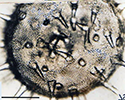
Seven plant species belonging to family Malvaceae were subjected to standard palynological studies in order to generate data for pollen characterization and identification of medicinally important mallows from Punjab, NW India. Pollen grains of this family are unique being porate and echinate having isolated spines. Pollen grains are either 3-porate, 6-7 porate or polypantoporate with oblate spheroidal shape and reticulate or semitectate reticulate exine. Based on various palynological parameters like the range in size, shape, aperture, exine thickness, ornamentation, etc. key to identification of presently studied taxa has been evolved.
Keywords
Full Text:
PDFReferences
Adekanmbi OP, “Pollen grains of Asteraceae and Analogous echinate grains”, Internatinal Journal of Botany, 5.4 (2009): 295-300. Print
Bates DM, “Generic relationships in the Malvaceae, tribe Malveae”, Gentes Herbarum, 10 (1968): 117-135. Print
Bera SK, Basumatary SK and Dixit S, “Studies on pollen morphology and phenological characteristics of some economically important arborescent taxa of tropical forest, lower Brahmaputra valley, Assam, North East India”, Journal of Palynology, 43 (2007) : 1-19. Print
Bibi N, Hussain M and Akhtar N, “Palynological studies of some cultivated species of genus Hibiscus from North west Frontier Province (N.W.F.P.) of Pakistan”, Pakistan Journal of Botany, 40.4 (2008) : 1561-1569. Print
Erdtman G, “Pollen morphology and plant taxonomy of Angiosperm”, In Introduction to Palynology, Waltham Mass Stockholm (1952). Print
Erdtman G, Bergland B and Praglowski J, “An Introduction to a Scandinavian Pollen Flora”, Vol. 1 Almqvist and Wiksell, Stockholm (1961). Print
Fryxell PA, “Generic relationships of Decaschistia (Malvaceae) and the description of a new tribe, Decaschistieae”, American Journal of Botany, 62 (1975): 172-175. Print
Fryxell PA, “Malvaceae of Mexico”, Systematic Botany Monograph, 25 (1988): 1-255. Print
Hutchinson J, “The genera of flowering plants (Angiospermae) Dicotyledones”, Vol. II. p. 659. London: Clarendon Press (1967). Print
Jain A, Choubey S,Singour PK, Rajak H and Pawar RS, Sida cordifolia (Linn) -An overview”, Journal of Applied Pharmeutical Science, 01.02 (2011) : 23-31. Print
Jain RK and Nanda S, “Pollen morphology of some desert plants of Pillani Rajasthan”, Palynological Bulletin, 2 & 3 (1966-67): 56-59. Print
Karna (Mallick) P, “Palynological Studies on Ten Species of Angiosperms from Nepal”, Internatinal Journal of Applied Sciences and Biotechnology, 5.3 (2017): 361-365. Print
Keshavarzi M, Abassian S and Sheidai M, “Pollen morphology of the genus Clypeola (Brassicaceae) in Iran”, Phytologia Balcanica, 18.1 (2012): 17-24. Print
Krebs G, “Taxonomische Untersuchungen in der Subtribus Malvinae”, Feddes Repert, 105 (1994 a): 7-18. Print
Krebs G, “Taxonomische Untersuchungen in der Subtribus Malvinae II, Dinacrusa”, Feddes Repert, 105 (1994 b): 299-315. Print
La Duke JC and Doebley JA, “Chloroplast DNA based phylogeny of the Malvaceae”, Systematic Botany, 20 (1995): 259-271. Print
Naggar SM, “Pollen Morphology of Egyptian Malvaceae: An Assessment of Taxonomic Value”, Turkish Journal of Botany, 28 (2004): 227-240. Print
Nair PKK, “Pollen grains of Western Himalayan plants”, Asia monograph no. 5 India (1965). Print
Nair PKK, “Essentials of Palynology”, Asia Publishing House Bombay (1966). Print
Perveen A, “A contribution to the pollen morphology of the family Gramineae”, World Applied Science Journal, 1 (2006): 60-65. Print
Perveen A and Qaiser M, “Pollen flora of Pakistan-1.Malvaceae: Dombeyoideae- LXII”. Pakistan Journalof Botany, 14 (2009): 491-494. Print
Perveen A, Siddiqui S, Fatima A and Qaiser M, “Pollen flora of Pakistan-1.Malvaceae”, Pakistan Journal of Botany, 26.2 (1994): 421-440. Print
Rao AR and Shukla P, “Pollen flora of Upper Gangetic Plains, Indian pollen spore flora Vol. I”, Today and Tommorow printers and Publishers, New Delhi (1975). Print
Reitsma T, “Suggestions towards unification of description terminology of angiosperm pollen grains”, Review of Palaeobotany and Palynology, 10 (1970): 39-60. Print
Samuel AJ, Mohan S, Chellappan DK, Kalusalingam A and Ariamuthu S, “Hibiscus vitifolius (Linn.) root extracts shows potent protective action against anti-tubercular drug induced hepatotoxicity”, Journal of Ethnopharmacology, 141.1 (2012): 396-402. Print
Sanghai DB, Kumar SV, Srinivasan KK, Aswatharam HN and Shreedhara CS, “Pharmacognostic and phytochemical investigation of the leaves of Malvastrum coromandelianum (L.) Garcke”, Ancient Science of Life, 33.1 (2013): 39-44. Print
Selling OH, “Studies in Hawaiian Pollen Statistics, Part I and II”, Bishop Museum Publ. Honolulu, Hawaii (1946-47). Print
Shah NA, Khan MR and Nigussie D, “Phytochemical investigation and nephroprotective potential of Sida cordata in rat”, BMC Complementary and Alternative Medicine, 17 (2017): 388. Print
Shaheen N, Khan MA, Hayat MQ and Yasmin G, “Pollen morphology of 14 species of Abutilon and Hibiscus of the family Malvaceae (sensu stricto)”, Journal of Medicinal Plants Research, 3.11 (2009): 921-929. Print
Vaidhya BL, “Study of Cytogenetic Diversity in Ranunculaceae”, (Unpublished doctoral dissertation). Central Department of Botany, Institute of Science and Technology, Tribhuvan University, Kirtipur, Kathmandu, Nepal (2005). Print
DOI: https://doi.org/10.21746/aps.2018.7.3.13

Copyright (c) 2018 Annals of Plant Sciences

This work is licensed under a Creative Commons Attribution-NonCommercial-NoDerivatives 4.0 International License.

